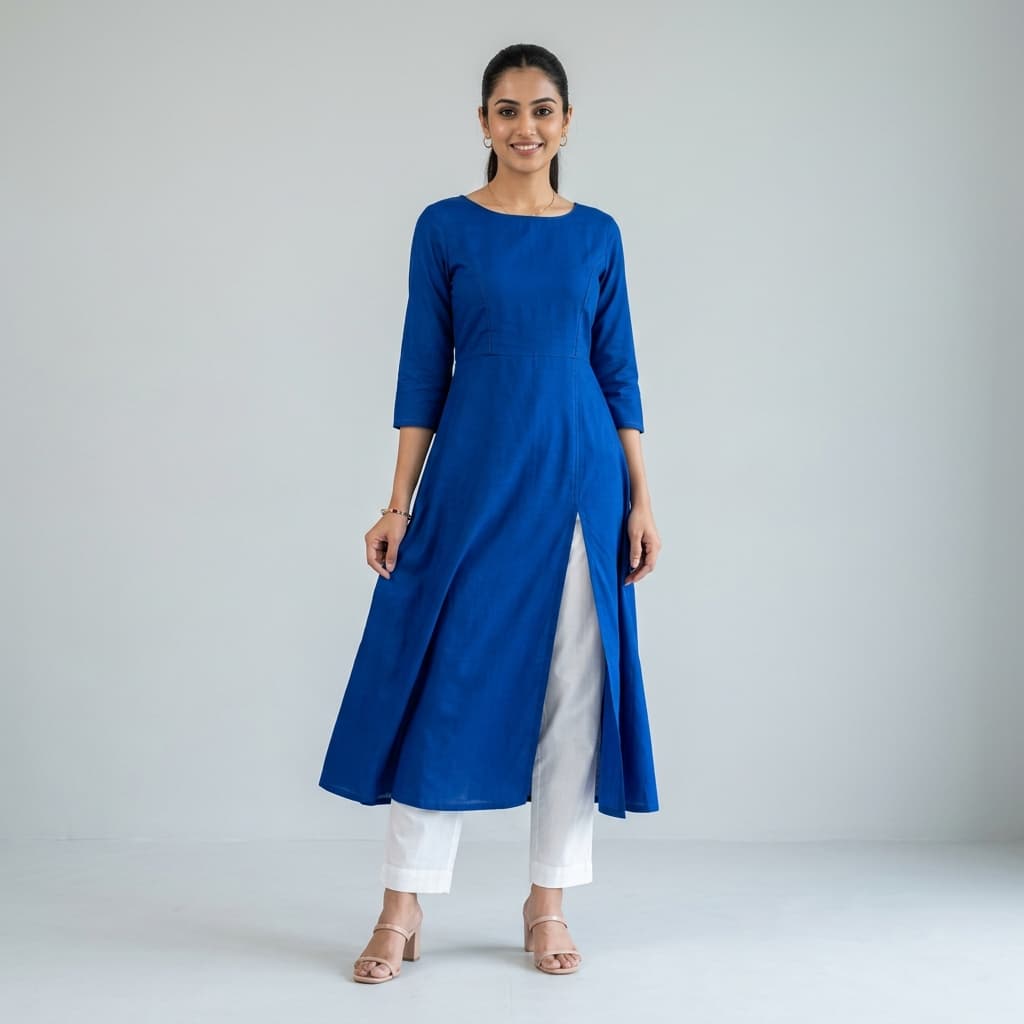
If you run an ethnic wear brand, your catalog likely contains a mix of both sarees and kurtis. When building a digital workspace, it is important to understand the technical difference between a saree mockup and a kurti mockup, and how E-Degin handles both.
Saree Mockup: 3D Draping Simulation A saree is a single sheet of unstitched fabric, meaning its appearance is entirely defined by how it is folded and wrapped. - **Complexity:** High. The fabric wraps around the waist, forms pleats at the front, and drapes over the shoulder. - **User Inputs:** Requires three separate design components: the blouse fabric, the main body fabric, and the decorative pallu fabric. - **AI Task:** The AI must run physics-based fabric drape calculations to warp these patterns around a model's pose realistically.
Kurti Mockup: Pattern Tailoring Simulation A kurti is a stitched garment with fixed seams, sleeves, necklines, and side cuts (like straight, A-line, or Anarkali styles). - **Complexity:** Medium. The shape of the garment is pre-defined; the challenge is mapping the print pattern smoothly over the stitched parts. - **User Inputs:** Usually requires only one input: a flat fabric repeat pattern. - **AI Task:** The AI applies the fabric pattern onto a 3D apparel template, aligning the prints with the seams and sleeve folds.
Getting the Most Out of E-Degin Whether you need to launch a new silk saree collection or showcase your latest block-printed kurtis, E-Degin provides dedicated generator modes for both: - Use the **Saree Generator** to weave custom combinations of blouse, body, and pallu. - Use the **Kurti/Salwar Generator** to instantly see how a single textile repeat pattern looks tailored into diverse kurti silhouettes.
Transform Your Ethnic Wear Business With AI
Ready to generate premium saree, kurti, and suit mockups like the ones featured in this guide? Register a free account today and get 3 credits to start immediately.
Start Creating Free